As part of our commitment to the ongoing health and wellbeing of the Italian Greyhound breed, we conducted a breed health survey in 2025. The Royal Kennel Club strongly encourages breed clubs to carry out such surveys to gather essential data, which helps us identify and address potential health concerns within our beloved breed.
Thank you to everyone who completed the Breed Health Survey, our Breed Health Coordinator, Joanne Liddy, has collated all the information from the results, which are published below.
The findings from this survey allow us to make informed decisions and recommendations to safeguard the future health of Italian Greyhounds.
Thank you for your time and support in helping us care for this wonderful breed.
Italian Greyhound Club – 2025 Breed Health Survey Report
Introduction
In January 2025, the Italian Greyhound Club conducted a comprehensive Breed Health Survey to gather up-to-date information on the health and care of Italian Greyhounds in the UK. The Kennel Club strongly encourages breed clubs to carry out such surveys to collect essential data for identifying potential health concerns. The survey was open to all UK-based Italian Greyhound owners – including both Kennel Club (KC) registered and non-registered dogs, and both club and non-club members – in order to build as complete a picture as possible of the breed’s health status. Owners participated anonymously via an online questionnaire, which closed on 31 January 2025 with an excellent response rate of 284 dogs.
This report presents a formal analysis of the 2025 survey findings for publication by the Italian Greyhound Club. All survey questions and responses have been broken down into structured sections. Topics covered include the dogs’ demographics (age, gender, neuter status), pedigree registration and identification, origins (UK or imported) and how the dog was obtained, routine care practices (microchipping, vaccination, any DNA health testing), diet and exercise habits, and a thorough accounting of all health conditions observed. By compiling these results, the Italian Greyhound Club aims to identify common health issues in the breed and areas for improvement in care. The findings will help inform breeders, owners, and the Club’s health initiatives – ultimately guiding efforts to safeguard the future health and well-being of Italian Greyhounds.
Demographics of Dogs Surveyed
The survey included 284 dogs, with a gender split of 128 females (45%) and 155 males (55%). Around 53% were neutered. Overall, the gender distribution was relatively balanced, suggesting no strong gender bias in the ownership of Italian Greyhounds who participated in the survey.
The median age was approximately 5 years, with most dogs aged between 1 and 6 years. A small proportion were over 9 years, with a few reaching 13–15 years, reflecting the breed’s typical lifespan of 12–14 years.
Registration and Identification
Most (68%) the IGs were Kennel Club registered. Virtually all dogs (99%) were microchipped, reflecting compliance with UK law and responsible ownership.
Kennel Club Registration
Kennel Club (KC) registration status varied among the dogs. A majority of the IGs in the survey are registered with the KC, but a significant proportion are not.
Specifically, 194 dogs (68%) were Kennel Club registered, 70 (25%) were not KC registered, and 20 (7%) of owners were unsure or did not know the registration status of their IG.
This indicates that while most owners have Kennel Club documentation for their Italian Greyhounds, about one in four do not, and a small number are uncertain of their dog’s registration. Kennel Club registration can be an indicator of pedigree documentation, and these results show a mix of pedigreed and non-pedigreed (or unregistered) dogs in the community.
Neutering Status
Neutering (spay/neuter surgery) was roughly equally split in the surveyed population. 150 IGs (approximately 53%) were neutered (spayed females or castrated males), whereas 132 (47%) were not neutered and remained intact. This even split suggests a variety of owner preferences or circumstances regarding neutering. The decision to neuter often depends on factors such as breeding intentions, health advice, and personal preference, and the survey shows the community is divided on this aspect.
Microchipping
Microchipping is now a legal requirement for dogs in the UK, and the survey results reflect near-universal compliance with this rule. Nearly all surveyed Italian Greyhounds (278 out of 284 responses, ~97.9%) are microchipped. Only three owners (around 1%) reported that their IG was not microchipped, and a few did not answer the question. This very high microchipping rate demonstrates that almost all owners ensure their IG can be identified if lost or stolen, which is an important aspect of responsible dog ownership.
Origins and Acquisition of Dogs
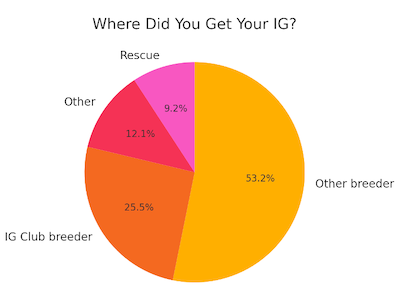
Owners obtained their Italian Greyhounds from a variety of sources. The survey particularly distinguishes between those acquired from breeders affiliated with the Italian Greyhound Club and those from other breeders, as well as rescue and other routes. The results show a clear pattern: the majority of dogs were obtained from breeders outside the IG Club, and a smaller portion came from IG Club-recommended breeders or from rescues. The breakdown is as follows:
– “Other breeder” – 150 dogs (53%)
– “IG Club breeder” – 72 dogs (26%)
– Rescue – 26 dogs (9%)
– Other (private sale/unspecified) – 34 dogs (12%)
The following pie chart illustrates this distribution.
The above results highlight that while the Italian Greyhound Club’s breeders contribute a significant portion of new puppies, a larger number of owners are getting their dogs from outside the official club network. This could be due to availability, convenience (finding a puppy online, for example), or other factors. The club and welfare organisations may take note that roughly one in every ten IGs is a rescue or rehome case, underlining the continued need for rescue efforts for the breed.
The breakdown is as follows:
- “Other breeder” – 150 dogs (53%): Just over half of the IGs were purchased from breeders not affiliated with the Italian Greyhound Club. These could include independent or commercial breeders, online-advertised litters, or breeders in other countries. It indicates that most owners went outside of the club’s breeder referral when getting their dog.
- “IG Club breeder” – 72 dogs (26%): About one-quarter of the dogs came from breeders who are members of or recognised by the Italian Greyhound Club. This suggests a significant minority of owners did obtain their IG through the club’s recommended channels, which often emphasise health testing and breed stewardship.
- Rescue – 26 dogs (9%): A modest number of Italian Greyhounds were acquired via rescue organisations or as re-homed dogs. These include dogs from IG rescue charities or other dog rescue centres. This figure (around one in eleven dogs) shows that rescue is a viable, though less common, path to acquiring an Italian Greyhound.
- Other (private sale/unspecified) – 34 dogs (12%): Some owners selected “Other” and explained unique circumstances, such as taking in an IG from a private rehoming (not through a formal rescue), inheriting the dog, or other less typical routes. These accounted for roughly 12% of responses.
While it’s encouraging that many owners are finding Italian Greyhounds through a variety of routes, the proportion of dogs obtained from outside the IG Club breeder network raises some concern. It is possible that some of these sources include commercial breeders or high-volume sellers—sometimes referred to as puppy farms—whether knowingly or unknowingly. The Club encourages prospective owners to research breeders carefully and consider those who follow best practices in health testing, socialisation, and breed stewardship. By doing so, owners can help support responsible breeding and promote the long-term welfare of the breed.
Overseas Origin
Most Italian Greyhounds in the survey were bred or obtained within the UK. Owners were asked whether they got their IG from the UK or abroad. 249 IGs (approximately 88%) were acquired within the UK, while 32 IGs (about 11%) were obtained from overseas. (A few respondents did not specify.) This shows that the vast majority of IGs in the survey are UK-bred or at least obtained in the UK, with a smaller subset of the dogs being imported or coming from other countries. Overseas IGs might include those imported for breeding or rescue, reflecting a minority in this sample.
Vaccination and Health Testing
Vaccination uptake among the surveyed IGs was high. 238 dogs (84%) were reported to be fully vaccinated, meaning they had received all routine vaccinations appropriate for their age. On the other hand, 42 dogs (15%) were not fully vaccinated. Additionally, 3 owners (about 1%) were unsure of their IG’s vaccination status. These figures suggest that a strong majority of owners keep their Italian Greyhounds up-to-date with vaccinations (such as core vaccines for canine parvovirus, distemper, etc.), although a notable minority have chosen not to vaccinate fully or were in lapses. Ensuring full vaccination is generally recommended to prevent infectious diseases, so it is positive to see a high rate of compliance in this group.
DNA Testing
DNA testing for known hereditary diseases (such as through the UC Davis genetic panel for Italian Greyhounds) was not very common among respondents. Only 53 IGs (19%) had been DNA tested for hereditary conditions. The majority – 198 dogs (around 70%) – had not undergone DNA testing, and 31 owners (11%) did not know if DNA tests had been done. This indicates that while a small segment of the community is proactive about genetic testing (perhaps for breeding or curiosity about health risks), most owners have not pursued these tests. Many pet owners may not find DNA testing necessary unless they plan to breed or if a test was recommended by a breeder/club. The relatively low uptake might also reflect the cost or limited awareness of such testing options.
Diet and Nutrition
Mixed was the most common diet (50%), followed by dry (22%) and raw (21%). A small number used wet or home-cooked food. Feeding practices varied widely across the sample, with many owners tailoring meals to their IG’s needs.
The breakdown of primary diet types is as follows:
- Mixed diet (multiple types) – Approx. 141 dogs (50%): About half of the IGs were fed a mixed diet. These diets include some combination of commercial foods and fresh foods. For example, owners reported mixing dry kibble with cooked meat/vegetables, or feeding raw diet alongside kibble or wet food. This suggests many owners tailor a varied diet to their dogs, rather than relying on a single food type.
- Commercial dry food (kibble) only – 63 dogs (22%): Around one in five IGs were fed exclusively on dry kibble diets. This category includes those who eat primarily commercial dry dog food (including breed-specific kibbles like Royal Canin, etc.) without significant additions of other food types.
- Raw diet only – 59 dogs (21%): A similar proportion (about one in five) were fed an exclusively raw diet (often referred to as BARF – Biologically Appropriate Raw Food). These dogs receive raw meat, bones, and other raw ingredients without cooked or kibble foods.
- Commercial wet food only – 17 dogs (6%): A smaller group of IGs were fed only wet food (such as canned or pouch diets). These complete wet diets are less common than dry food among the respondents, but a few owners prefer them.
- Home-cooked food only – 3 dogs (1%): A very small number of owners (just three cases) reported feeding an entirely home-cooked diet, meaning all the dog’s meals are prepared from scratch (cooked meats, vegetables, etc.) with no commercial pet food. Most owners who feed home-cooked meals appear to do so in combination with a commercial diet (hence counted in the “mixed” category), rather than exclusively.
Overall, the data show that roughly half of Italian Greyhound owners use a mixed feeding approach, combining different food sources, while the remainder are split between those sticking strictly to commercial diets (dry or wet) and those following strictly raw diets. Very few rely solely on home cooking. This diversity in feeding practices reflects differing philosophies on canine nutrition, as well as accommodation for individual dogs’ preferences or health needs (such as food sensitivities).
Exercise and Activity
About 50% of IGs received 30–60 minutes of daily exercise, 25% received 1–2 hours, and 20% received less than 30 minutes. Only a few had more than 2 hours per day. These figures show a generally healthy balance of activity levels among respondents.
Exercise needs for Italian Greyhounds are moderate, and owners’ responses about daily exercise duration varied. Most owners reported giving their IG between 30 minutes and 1 hour of exercise per day, often split into walks and playtime. A common response was around one hour daily. In fact, the single most frequent answer was “1 hour” (with around 15 owners specifying this exactly), indicating that many IGs get a roughly one-hour walk or activity each day.
Many other owners described exercise in ranges or multiple sessions: for example, “1–2 hours” per day or “one long or two shorter walks daily.” About 10–15% of owners indicated their dogs regularly get between 1 and 2 hours of exercise each day. A handful of owners (a small minority) provide more than 2 hours of exercise or long-distance runs (some mentioned distances like 2 miles or 5 km runs, which roughly correspond to extensive exercise sessions).
On the lower end, around ~5%–10% of dogs get 30 minutes or less of formal exercise per day. Several owners wrote “30 minutes” as the daily exercise, and a few even noted very minimal formal walks (e.g., “10 mins” or “1/2 mile per day”), often compensating with play in the garden. A few responses like “She chooses” or “Daily zoomies in the garden” imply that some IGs get exercise in the form of free play or on their own terms rather than structured walks.In summary, the typical Italian Greyhound in this survey gets around an hour of exercise each day, combining walks and play. Some get significantly more (especially younger or very active dogs), and some get less (possibly older or less active dogs), but virtually all have at least some daily activity. This level of exercise aligns with the breed’s needs – IGs enjoy daily walks and playtime, though they are also content to spend a lot of time lounging.
Health Conditions Reported
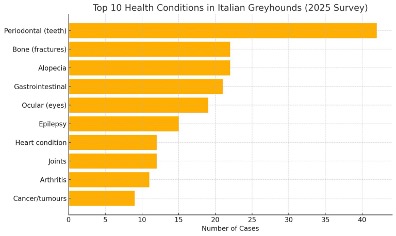
Figure: Top 10 Health Conditions Reported in the 2025 Italian Greyhound Health Survey (number of cases)
The most commonly reported health issue was periodontal disease, followed by bone fractures and alopecia. The chart below illustrates the top 10 conditions recorded, highlighting areas of ongoing concern for breed health.
Each owner was asked to indicate any health conditions that their Italian Greyhound has, from a provided list of common IG health issues (with the option to tick multiple conditions if applicable). They could select all that apply, and some provided additional details or other conditions not listed. Below is a complete breakdown of all health conditions reported in the survey, along with the number of cases (i.e. number of IGs reported to have that condition). If a dog had multiple issues, they are counted in each relevant category. The list is ordered roughly by frequency (most common issues first):
- Periodontal (dental) disease: 42 cases. Dental problems were the most frequently reported issue. Many IGs suffer from periodontal disease or tooth problems, which is not surprising given the breed’s tendency for dental crowding and tartar build-up. Owners frequently noted needing dental cleanings or extractions.
- Bone fractures (broken legs): 22 cases. A high number of IGs have experienced bone fractures, typically leg breaks. Italian Greyhounds have fine, delicate legs and are unfortunately prone to fractures from jumps or accidents. This was one of the top health issues in the survey, on par with alopecia in frequency.
- Alopecia (hair loss): 22 cases. Hair loss (alopecia) was another common condition, often associated with certain coat colours (e.g. colour dilution alopecia in blue or fawn IGs). Owners reported seasonal or patchy hair loss in these cases. While usually a cosmetic issue, it was commonly noted.
- Gastrointestinal issues: 21 cases. Digestive problems were frequently reported. These include chronic upset stomach, sensitive digestion, or bouts of vomiting/diarrhoea. Some owners described their IGs as having very sensitive stomachs or food intolerances. Gastrointestinal issues appear to be a fairly common concern in the breed.
- Ocular (eye) issues: 19 cases. Eye problems, such as cataracts, progressive retinal atrophy, or other ocular conditions, were noted. A few owners mentioned glaucoma or eye injuries, and many ticked the general “ocular (eyes)” category. Eye health is clearly something that affects a subset of IGs, with about 19 cases in the survey.
- Epilepsy (seizures): 15 cases. A number of Italian Greyhounds have experienced seizures or been diagnosed with epilepsy. 15 owners (≈5% of the dogs) reported seizure disorders. Some described isolated or “petit mal” seizures, and one mentioned myoclonic seizures. Epilepsy can range from mild and infrequent to more severe, and it appears in the breed at a moderate rate.
- Heart conditions: 12 cases. Heart issues, including heart murmurs and other cardiac conditions, were reported in 12 dogs. A few owners specified the grade of heart murmur (e.g. Grade 1 or Grade 3/4 murmurs). Heart diseases in IGs can include valve disorders or congenital defects, and while not among the top three issues, a notable number of cases were present (about 4% of dogs).
- Joints (e.g., luxating patella): 12 cases. Joint problems, most commonly luxating patella (loose kneecaps), were reported in about a dozen dogs. Some owners ticked a general “joints” category or specifically mentioned patella luxation. This condition can cause lameness or difficulty in movement and is relatively common in small breeds like IGs.
- Arthritis: 11 cases. Apart from acute injuries or patella issues, some IGs suffer from chronic arthritis (degenerative joint disease), often as they age or secondary to injuries. 11 cases of arthritis were noted, indicating that about 4% of the IGs have arthritis problems managed by their owners (for example, stiffness, pain, or use of anti-inflammatory medication).
- Cancers & tumours: 9 cases. Tumours (benign or malignant) were reported in 9 IGs. These included mentions of cancers and lumps (for instance, one owner noted benign liver nodules, another mentioned past removal of tumours). Cancer can occur in Italian Greyhounds as in any breed, and roughly 3% of the surveyed dogs have had some form of tumour or cancer diagnosis.
- Dermatological (skin or allergy) issues: 7 cases. Skin conditions, including allergies, dermatitis, or other chronic skin problems, were reported in 7 dogs. Some owners mentioned allergies (such as possible food or environmental allergies causing itching or rashes). While not extremely common, skin issues do affect a subset of the breed. This category does not include alopecia (hair loss), which was counted separately above; if combined, skin/coat issues in general would be higher.
- Autoimmune disorders (e.g., SRMA/IMPA): 4 cases. A few dogs (4 cases) were noted to have autoimmune disorders. This includes conditions like steroid-responsive meningitis-arteritis (SRMA) or immune-mediated polyarthritis (IMPA). For example, one owner described a dog with steroid-resistant meningitis/arthritis, and another mentioned IMPA specifically. These are relatively rare but serious conditions where the immune system causes significant inflammation (in the meninges, joints, or elsewhere). The survey shows only a small number of IGs with such autoimmune conditions.
- Urinary & kidney issues: 3 cases. A small number of IGs have had urinary or kidney problems. These might include chronic kidney disease, frequent urinary tract infections, or bladder stones. Only three cases were noted (just over 1% of dogs).
- Endocrine (other hormonal) issues: 3 cases. Endocrine disorders aside from Addison’s (addressed below) were rare. There were a couple of mentions of hypothyroidism (low thyroid function) in the dogs, which falls under this category. Hypothyroidism was explicitly noted in 1 case, and a few others ticked a general “endocrine/hormonal” issue. This suggests hormonal imbalances are not a major widespread issue in the breed, apart from specific conditions like Addison’s.
- Aural (ear) issues: 2 cases. Ear problems (such as chronic ear infections or ear canal issues) were not very common, with only two owners indicating aural issues. This could include things like persistent otitis. Italian Greyhounds, with their rose ears, are not as prone to ear infections as some floppy-eared breeds, which may explain the low number.
- Addison’s disease: 1 case. Only one Italian Greyhound was reported to have Addison’s disease (hypoadrenocorticism) in this survey. Addison’s is a serious endocrine disorder affecting the adrenal glands and can be life-threatening if not managed. It is known to occur in IGs (as an autoimmune condition) but appears to be uncommon in this sample (0.35% of dogs).
- Other unique conditions: Various other individual health issues were each reported in one dog (single cases). These were not common across the survey population but are worth noting as part of the complete health picture:
- Cleft palate: 1 case. A congenital cleft palate was reported in one IG (a birth defect affecting the mouth).
- Anal gland issues: 2 cases. Two dogs had problems with anal glands (one owner noted anal gland blockages and another an anal abscess). These can cause discomfort and require veterinary attention, though not a widespread issue in the breed.
- Severe anxiety (behavioural issue): 1 case. While not a physical illness, one owner reported their IG had high anxiety requiring veterinary behavioural support and medication. This highlights that mental or behavioural health can be a concern for some IGs.
- Deformed limb due to inbreeding: 1 case. One owner mentioned their dog has a limb deformity attributed to inbreeding. This is a very uncommon scenario and not a typical breed health condition, but it was recorded by that respondent.
Top Ten Reported Health Conditions
The following table lists the ten most frequently reported health conditions and the number of IGs affected:
| Health Condition | Number of Cases |
| Periodontal (teeth) | 42 |
| Bone (fractures/breaks) | 22 |
| Alopecia | 22 |
| Gastrointestinal | 21 |
| Ocular (eyes) | 19 |
| Epilepsy | 15 |
| Heart condition | 12 |
| Joints | 12 |
| Arthritis | 11 |
| Cancer/tumours | 9 |
The health condition breakdown reveals that dental problems and bone fractures are the top issues facing Italian Greyhounds, followed by alopecia, digestive issues, eye problems, and epilepsy. Many other conditions exist but at lower frequencies. These findings can help inform Italian Greyhound owners about common health risks and encourage preventive care (such as regular dental cleanings and safe handling to avoid injuries). Breed enthusiasts and veterinarians can also use this information to prioritise health screening and education (for instance, emphasising patella checks or awareness of seizure symptoms).
It is worth noting that many of the common issues are manageable: dental care (like regular teeth cleaning) can address periodontal disease, and careful handling and jumping prevention can mitigate fracture risk. Alopecia in IGs is often cosmetic. Gastrointestinal sensitivities may require special diets. On the more serious end, conditions like epilepsy and heart murmurs require veterinary management, and thankfully only a small fraction of dogs have the very severe autoimmune conditions. The data from this survey can guide owners and breeders on which health areas to monitor closely (for example, maintaining good dental hygiene and preventing injuries).
Conclusion
The 2025 Italian Greyhound Health Survey provides essential insight into the health and well-being of the breed in the UK. It confirms areas of strength, such as high rates of microchipping and vaccination, and identifies key areas of concern, including dental disease, fracture risk, and gastrointestinal sensitivity. The survey also reveals patterns in diet, exercise, and acquisition sources, supporting the Club’s ongoing educational efforts. By publishing these findings, the Italian Greyhound Club aims to promote best practice among owners and breeders and to encourage data-driven improvements in breed health.
Overall, the survey paints a picture of a breed that is well-cared for by its owners, with high compliance in microchipping and vaccination. It also underlines areas for improvement, such as increasing the use of health testing and encouraging practices that reduce common health problems. By sharing these results, the Italian Greyhound community can continue to work together to improve the health and well-being of these dogs for years to come.
Joanne Liddy, Italian Greyhound Breed Health Coordinator for the Royal Kennel Club.
Download the Royal Kennel Club’s Population Analysis of the Italian Greyhound here.